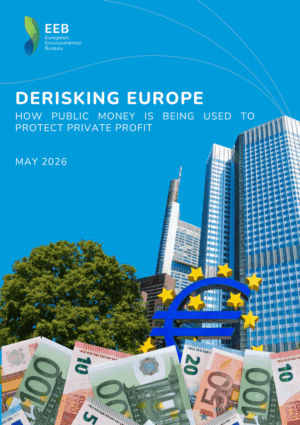

Derisking Europe: How Public Money Is Being Used to Protect Private Profit Derisking Europe
As the European Union pushes ahead with its industrial ambitions, a new financial approach has quietly become central to its strategy: derisking. It sounds technical, and it is, but it is also deeply political. Derisking is also not limited to industrial policy. In times of austerity, tight fiscal rules, limited public funds, higher interest rates, and political resistance to raising taxes, policymakers have turned to derisking instruments in other policy areas, such as social, climate, and infrastructure, to close investment gaps.
Derisking has become a central part of Europe’s response to multiple crises, including industrial decline, the climate crisis, and social pressures. Increasingly, these challenges are framed as problems of finance and investment rather than problems of public provision and ultimately political will. With public budgets self-constrained, governments are relying more on private finance and using derisking tools to direct private capital toward public goals, often at the cost of democratic control and public ownership.
Derisking is not just a financial tool. It marks a profound shift in how Europe conceives public investment, industrial policy, and the role of the state. Instead of expanding public capacity, it often shifts risks from private investors to the public while giving private actors greater influence over which projects move forward.
Derisking is closely linked to deregulation. By reducing regulatory barriers, speeding up permitting, and simplifying state aid rules, the EU creates an “investment-friendly” environment designed to attract private capital. In practice, this means public institutions take on more financial risk while loosening oversight and conditions for private investors. Together, derisking and deregulation shift Europe’s economic model away from direct public provision and control toward one focused on supporting, subsidising, and absorbing risk for private finance.
This brief aims to outline some risks behind this approach and present alternatives.
©2026 EEB

Manage Consent
Functional
Always active
The technical storage or access is strictly necessary for the legitimate purpose of enabling the use of a specific service explicitly requested by the subscriber or user, or for the sole purpose of carrying out the transmission of a communication over an electronic communications network.
Preferences
The technical storage or access is necessary for the legitimate purpose of storing preferences that are not requested by the subscriber or user.
Statistics
The technical storage or access that is used exclusively for statistical purposes.
The technical storage or access that is used exclusively for anonymous statistical purposes. Without a subpoena, voluntary compliance on the part of your Internet Service Provider, or additional records from a third party, information stored or retrieved for this purpose alone cannot usually be used to identify you.
Marketing
The technical storage or access is required to create user profiles to send advertising, or to track the user on a website or across several websites for similar marketing purposes.