Seven in ten across Europe say biggest polluters and climate laggards should pay more, challenging rollback of EU ETS
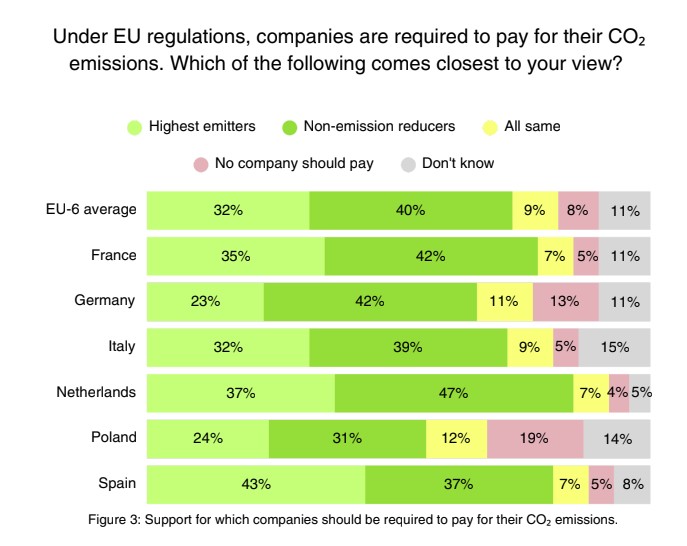
Brussels/Berlin, 1 July 2026 – Seven out of ten European citizens (72%), including those voting for parties often portrayed as sceptical of EU climate policy, believe that companies that emit the most – or fail to reduce their emissions – should pay more.(1) A new poll, commissioned by Beyond Fossil Fuels on behalf of a broad community of organisations, and conducted by YouGov across six European countries, finds broad support for the “polluter pays” principle at the heart of the EU Emission Trading Scheme (ETS), cutting across national and political divides.(2)
As the European Commission prepares to reveal its proposal for the EU ETS on 15 July, the poll’s findings challenge calls from industry and political leaders to weaken the mechanism, revealing widespread public support for its core principles: making polluters pay, rewarding industrial decarbonisation. Citizens also support that if companies continue benefitting from free allowances, they must come with conditions attached.
Carlota Ruiz Bautista, Steel and Industry Campaigner at Beyond Fossil Fuels, said:
“The war in the Middle East is once again showing Europe the cost of fossil fuel dependence, in geopolitical risk, energy insecurity, and economic fragility. European citizens get it: you can’t have a resilient industry without a clean one. Political leaders must now listen to their citizens and stop letting big polluting companies like ArcelorMittal, Thyssenkrupp, Voestalpine and BASF hollow out the EU ETS, the very mechanism designed to drive that green industrial transformation.”
A majority of 59% of respondents across France (66%), Germany (47%), Italy (65%), the Netherlands (71%), Poland (40%) and Spain (68%) think that heavy industries, such as steel, cement, and chemicals, should pay for their CO₂ emissions. Support rises to more than two-thirds in Spain, France, Italy and the Netherlands, while opposition across the six countries stands at just 23%. Beyond pricing polluters, respondents also expect the system to reward climate ambition, with 7 out of 10 participants believing that companies emitting the most – or failing to reduce their emissions – should pay more than others.
Support goes well beyond the “green electorate”, including even voters of governing parties that have called for changes to or a weakening of the EU ETS. This becomes strikingly clear in Italy, where 71% of voters of Fratelli d’Italia, the party led by Prime Minister Giorgia Meloni, express support for making heavy industries pay for their emissions. In France, 73% of Emmanuel Macron’s voters and 55% of Marine Le Pen’s voters back the same principle. In Poland, 57% of voters of Koalicja Obywatelska (KO), led by Prime Minister Donald Tusk, are in support.
The latest attack on the Emissions Trading System by steel giants ArcelorMittal, ThyssenKrupp and Voestalpine and chemicals giant BASF marks one of industry’s most direct calls yet for the EU to retreat on climate action. However, citizens want to stay the course. One in two respondents (50%) favour governments collecting carbon revenues and investing them directly in industrial decarbonisation, compared with just 18% who believe energy-intensive industries should not have to pay for their carbon emissions at all. Where companies continue to benefit from free allowances, 62% believe these should only happen on the condition of investing in reducing future emissions. Meanwhile, 63% believe this should only happen if energy-intensive industries support a just transition for workers by investing in workforce reskilling, staff training and high-quality working conditions.
The poll’s results show that citizens are ahead of the political debate. They back making heavy industry pay for its emissions, favour investing carbon revenues in industrial transformation, and expect any support in the form of free allowances to come with conditionalities that cut emissions and deliver benefits for workers and communities.
Duncan Woods, Senior Policy Officer for Industrial Decarbonisation at EEB, said
“The ETS may be a technical piece of legislation, but Europeans have a clear view on its core principle: polluters should pay for the pollution they cause. Yet, in the run-up to its revision, some governments are pushing in the opposite direction. This poll shows they are not speaking for their own citizens and voters. Europeans also reject blank cheques for industry. If companies continue to receive free allowances, they expect them to invest in cleaner production and just transition. The Commission should take its mandate from citizens, not from industry laggards”
ENDS
More information on YouGov’s survey results can be found in our briefing.
